Sensory overload does not announce itself with a siren. It creeps in through fluorescent flicker, the chorus of keyboards, a wool tag grinding the back of your neck. For many autistic, ADHD, and otherwise neurodivergent folks, overload is a daily negotiation with light, noise, motion, smell, and social energy. It can look like irritability that comes out of nowhere, a migraine brewing by lunch, words disappearing when you need them, or a sudden need to bolt from a room that feels fine to everyone else.
I have sat on therapy floors with clients who carry ear defenders everywhere and still end up curled on the kitchen tiles after grocery shopping. I have coached a software engineer who lost a promotion because the open plan office knocked out his working memory by 3 p.m. Most can explain their suffering, but fewer have been shown how to engineer their environment, body, and schedule in a way that keeps their nervous system inside a workable window.
Neurodivergent therapy takes overload seriously as a real and valid signal. It does not treat it like a personal failure to toughen up. It builds practical routines around a person’s sensory profile, relationships, and responsibilities, with tools that are small enough to use at a bus stop and durable enough to help in a board meeting. What follows are field-tested ideas that combine clinical knowledge with problem solving from kitchens, cubicles, classrooms, and cars.
What overload actually is, and why that matters
From a nervous system standpoint, overload is not just too much input. It is too much input arriving too fast for your brain to prioritize, filter, and respond. For some, the volume knob is stuck on high. For others, it is the speed of switching that burns resources. After a while, the cost shows up as fight, flight, freeze, or fawn. You may snap at a partner, check out mid-sentence, or become agreeable to things you do not want because you need the conversation to stop.
This state has nothing to do with maturity or willpower. It is about thresholds and recovery time. If you are autistic, ADHD, or living with chronic pain, PTSD, migraines, or sleep apnea, your threshold and recovery patterns likely differ from the people writing your office policies. Trauma therapy often reveals how a sensitized nervous system maps modern environments as potential threats, so the same strip mall that is neutral to one person can register as a threat landscape to another. A neurodivergent therapy lens validates this difference and plans around it.
Build a personal sensory map
Before buying gadgets, spend a week learning the shape of your input. The goal is a living map, not a diagnosis. Track time of day, context, and the first three signals your body sends when it is nearing the edge. Common early signals include shoulder tension, fast blinking, a sudden need to pee, thirst, fidgeting that turns frantic, or a felt sense of heat under the skin. Note specifics. “Noisy” is vague. “Pitch of forks on plates at 6 to 8 feet” is useful.
Rather than a giant spreadsheet, use a notes app and write short lines after events. One client wrote “Staff meeting. Vent fan, perfume row 3, window glare on table. Speech felt sticky. Needed sunglasses at minute 22.” After six entries like that, the pattern wrote itself. You might learn that perfumes do not bother you, but overhead LEDs do, and only when they reflect on glossy surfaces. That points you toward matte covers and a seat change, not a global solution that makes life harder than it needs to be.
Micro-adjustments at home that make a real difference
Home is where you refill. If home quietly drains you, everything else gets heavier. Small changes are often better than a renovation.
Light is the first place I look. If you tolerate warm temperatures, replace bright cool bulbs with warm 2700K. That one number matters. Calibrating lamps at two heights gives you options at dusk and dawn, which are odd sensory times. In a kitchen, under-cabinet strips with a dimmer reduce overhead glare on counters. In bathrooms, diffuse rather than spot lighting helps during morning rush when you least need a blast.
Sound is next. Many clients describe the fridge and HVAC as the soundtrack of their stress. A simple fix is to run a low, constant sound that you choose, like a fan on a stable setting, so sudden noises ride on a consistent floor. That soft floor can shave off the spikes that trigger startle. If you share walls with neighbors, placing bookcases along the loud wall is an old trick that still works. Heavy curtains that seal at the sides can cut late-night street bursts by a surprising percentage.
Textures matter more than people admit. Sofas that feel fine in a store can overactivate you if the fabric grabs your skin. If replacing furniture is not possible, thin cotton throws turn a scratchy surface into something your nervous system stops tracking. In the closet, snip tags, learn which seams upset you, and duplicate your favorite shirt rather than reinvent your wardrobe each season.
Smell is a wild card. If scented detergent follows you through the day, switch to unscented for a month and see if your migraines or irritability ease. Kitchen smells can linger. Run a small air purifier at night to reset the room for morning. The goal is to make home the place your nervous system can drop two notches on its own.
Commuting and public spaces without the crash
Public transport, grocery stores, malls, and airports stack stimuli in layers that you cannot control. Control what you can. Sunglasses with a high level of visible light reduction help with refracted light on train windows. For some, yellow lenses are better than dark tint because they cut blue light without plunging you into a cave. On buses and trains, back-corner seats reduce flow-by movement. If you get motion sick when you cannot predict acceleration, face forward and watch a fixed point.
Grocery stores are loud, bright, and pushy. Shop during off hours if you can. Fifteen minutes after opening or 90 minutes before close are usually less intense. Ask customer service for unscented checkout wipes or bring your own. Use self-checkout if speech is hard at the end of a run. Many stores will bag for you if you ask simply and directly. “I have a sensory disability. Please bag these.” A short sentence spares you from needing to justify yourself.
Airports combine glare, PA systems, rolling suitcases, perfume clouds, and hunger. Eat a small protein snack before security. Blood sugar swings worsen overload. Noise-canceling headphones help, but not for everyone. Some prefer earplugs that lower the world rather than silence it. If you get startled by sudden announcements even with headphones on, one earplug plus one on-ear muff can be the right middle ground. Yes, you will look like a pilot. No, you do not owe strangers a comfortable view.
Work and school that do not cost your whole bandwidth
Open offices are built for collaboration on paper and for sensory chaos in practice. If a private office is not available, a neighborhood desk near a wall cuts 180 degrees of visual motion. Ask to swap your seat for a corner. People say yes more often than you think when you explain your productivity doubles with a wall at your back. Use lamps rather than overhead lights where policy allows. If you cannot change overheads, use a baseball cap or brimmed hat to cut glare. Frame it as a migraine accommodation if you need to in order to fit HR categories.
Work from home is not automatically easier. Your house may hold kids, pets, and leaf blowers. Build a small, repeatable start ritual. Two minutes of standing calf raises plus 30 seconds of cold water on wrists can prime the system. Keep a tactile focus object at your desk, like a smooth stone or worry coin, for meetings where video off is not an option. Video off should be the default accommodation. Many managers will agree when you tie it to performance. “If I can reduce visual input, I think faster and retain more. That helps our deadlines.”
In school, fluorescent flicker and crowded halls create predictable overwhelm. Students who have access to noise-reducing earmuffs and sunglasses make it farther into the day with less fallout. Advocate for flexible seating, permission to leave class without speaking, and alternate test locations. These are standard supports and do not require exotic plans. When a student receives child therapy that includes sensory education for the family, the morning and after-school transitions usually improve as well. Teachers who understand a student’s sensory map often care enough to join the solution.
The body is part of the environment
People look outward for sensory fixes and forget the body is a major input and output channel. Low blood sugar, dehydration, sleep debt, and hormonal shifts thin your buffer. You do not need a perfect diet to get relief. You need stable fuel and simple, mechanical resets.
Chewing is a powerful regulator, especially for ADHD. Keep gum with a medium bite that lasts. Crunchy snacks can help too, but chewing gum has the advantage of zero crumbs during a meeting. Breath is another lever. Long exhales tell your nervous system it is safe enough to exit high alert. Try a 4 in, 6 out rhythm for a minute, eyes down and soft, mouth slightly open. If counting makes you anxious, hum while exhaling. Vibration down the throat and chest can be soothing without forcing numbers on your breath.
Isometrics are tiny strength holds that feed the body proprioceptive input without movement that draws attention. Press your hands together under a table for 10 seconds, rest 10 seconds, repeat twice. That load on your shoulder girdle can settle a buzzy upper back and jaw.
A 30-second reset you can use anywhere
- Plant your feet hip width, toes finding the inside edge of your shoes. Look down and soften your gaze to the space about two feet ahead. Inhale through your nose, then exhale slowly through pursed lips for twice as long, three times. Press your tongue softly to the roof of your mouth, then unclench your jaw.
It is not magic. It buys you room to choose your next move rather than reacting.
When overload and trauma meet
Not every overload is trauma-related, yet the overlap is common enough to name. If you have a history of medical trauma, assault, bullying, or neglect, your system may treat certain sights, sounds, or touches as danger even if your adult brain knows you are at a staff picnic. Trauma therapy helps teach the body and brain to separate then from now. That can involve education, gradual exposure to triggers with support, and building a bank of skills, like the reset above, that shifts your physiology.
EMDR therapy is often useful for neurodivergent clients when it is adapted. Traditional EMDR uses bilateral stimulation with eye movements or taps while recalling aspects of traumatic memories. For clients with sensory sensitivities, the speed, sound, or light bars can be too much. A slower pace, tactile buzzers in socks rather than in hands, or switching to tapping the shoulders can make the same process tolerable. Some clients need shorter sets and longer rests, with breaks to orient to the room and ground in safe sensory input like a weighted lap pad. The key is a therapist who understands sensory thresholds and prioritizes consent over protocol speed.
Couples therapy through a sensory lens
Partners often read overload as rejection or disinterest when it is really the nervous system hitting a wall. Couples therapy that includes a sensory lens changes the script. Instead of “You never listen to me after work,” it becomes “When I get home, my head is ringing. I want to want conversation. I need 20 minutes to quiet the noise, then I can track you fully.” That shift invites collaboration.
Teach brief co-regulation. The partner who is less overloaded can speak in fewer words, one idea at a time, with longer pauses. Light touch should be negotiated. What soothes one day might irritate another. Sitting side by side rather than face to face often helps. A shared ritual matters, like stepping outside together for three minutes to look at a far horizon. Visual distance gives internal space. An honest plan for overstimulating events is intimacy, not avoidance. Agree in advance on a word or gesture that means a short break. Promise that you will come back. Keep that promise.
Parenting, advocacy, and child therapy
Families often carry multiple neurotypes. A toddler who melts down at the sound of the blender might have a parent who shuts down in the cereal aisle, and a sibling who seeks noise and touch. Child therapy that respects sensory differences can reduce punishment cycles that come from misunderstanding. Therapists help kids name what they feel in their body and pick one tool at a time. For a grade-schooler, that might be a chew necklace approved by the teacher, a fan card that lets them walk to the hallway water fountain, and a morning routine that includes five minutes under a blanket fort with a flashlight and a book. That five minutes can be the difference between a day full of minor explosions and a day that simply feels long.
School advocacy can be specific and grounded. Bring your child’s sensory map to 504 or IEP meetings. Show how fluorescent lighting translates into headaches by 10 a.m. Ask for a seat near natural light, permission to use hats or tinted lenses, and extra passing time so crowded halls do not derail the next lesson. Explain that test performance rises when background noise drops. Tie requests to measurable outcomes. Most schools want kids to learn. Give them a clear bridge between your child’s needs and their goals.
Your portable kit for hard places
- Earplugs with a known dB reduction and a case, plus a spare set. Sunglasses that actually fit your face and do not slide. A small, unscented hand lotion for tactile reset on the go. Protein snack and a pack of gum to stabilize energy and chew. A smooth stone or fabric square that your hands like to feel.
Keep the kit in a bag you already carry. Rehearse using each item before you need it in a crisis. Your body trusts what it has practiced.
Tech that helps without taking over
Apps and gadgets can help if they are servants, not bosses. Sound meters on your phone teach you which places are objectively loud and which only feel loud because of pitch or echo. Light meter apps show that your office is at 800 lux when your eyes prefer 300 to 500. That gives you leverage to ask for adjustments. Wearables that track heart rate variability can hint at overload brewing, but do not fixate on the numbers. Notice trends. When your evening HRV drops consistently after Tuesday staff meetings, build a plan for Tuesdays rather than trying to micromanage your pulse.
Noise-canceling headphones are a tool, not a mask. Some people feel dissociated or dizzy if they wear them for hours. Use them in bursts or switch to passive earmuffs. For screen glare, f.lux or night shift modes that shift color temperature in the afternoon can help if your work is not color critical. If you are sensitive to PWM flicker in screens, research models with DC dimming. Your eyes might stop burning by noon.
Body doubling and task design
ADHD brains and many autistic brains respond well to body doubling, the practice of working in parallel with another person to anchor attention. This is not small talk. It is quiet co-presence. Use a shared silent video call or sit in the same room facing different directions. Agree on intervals, like 20 minutes of work, two minutes of break. The other person’s gentle structure can trim anxiety about when to start, which lowers sensory vigilance overall.
Task design matters too. Batch loud or tactilely unpleasant tasks into one window, then plan a reset that fits the input. If you vacuum, then mop, then scrub a bathtub, accept that your skin and ears will be buzzing. Do not try to make a phone call next. Schedule a reset. That could be a five minute walk without headphones, or a shower in a dark bathroom with one candle, or lying on the floor with your feet up on the couch. Label it recovery, not laziness. Recovery is the cost of getting the job done.
When medication and medical checks belong in the conversation
Some overload softens when medical contributors are treated. Iron deficiency, thyroid disorders, perimenopause, sleep apnea, and chronic sinus issues all change sensory tolerance. If your startle reflex has spiked over the last six months, and your sleep is loud with snoring, get a sleep study. If your scalp itches and your heart pounds after coffee, try half-caf or separate caffeine from sugar. ADHD medication often improves sensory regulation indirectly by reducing the mental clutter that makes noise and light harder to sort. Work with a prescriber who knows adult ADHD and autistic profiles well. Medication is not a cure. It is one more lever.
Cost, access, and the art of the workaround
Weighted blankets, custom earplugs, premium headphones, and light-filtering lenses can add up. You do not need all of it. Prioritize based on your sensory map. If groceries take you out, invest in earplugs and a cap. If mornings are brutal, spend on bedside lighting you control with a dimmer and a cheap timer. Look for used headphones. Try library study rooms. Many cities have tool libraries where you can borrow an air purifier to test before buying. Community clinics and nonprofits sometimes provide sensory kits for kids. Ask. People hoard knowledge about what helped them and often share when you name what you need.

Therapy that respects your nervous system
Neurodivergent therapy is not a single modality. It is a stance. It takes your reports of overwhelm as accurate data. It asks about your lived day before it chases diagnoses. A good therapist will help you test micro-changes at home and work, practice resets in session, and experiment with scripts for asking others to flex. If trauma therapy is part of your path, they will pace it so that your baseline tolerance is respected. EMDR therapy can be a tool, not a mandate. Somatic work, like noticing weight through your feet or orienting to the room, is often as practical as any insight.
Couples therapy with a sensory lens can prevent resentment from calcifying. It teaches both partners how to move through crowded parties, family dinners, and noisy holidays with a plan that protects the relationship. Child therapy that includes parents helps families replace shame with language and tools. The common thread is consent and collaboration.
A day stitched for less overload
Imagine a Tuesday for a client I will call Mara, a graphic designer with ADHD and migraines. Her mornings used to start with a phone alarm and ceiling light that felt like a hospital. By 9 a.m., she had a headache and by 2 p.m., she was behind and ashamed.
We changed small things. Her lamp turns on at 6:45 at 30 percent brightness and warms over 10 minutes. She drinks water before coffee, eats a boiled egg, and uses the 30-second reset while her computer boots. At work, she sits with her back to a wall and a matte screen filter. https://www.fuzzysockstherapy.com/ She wears a brimmed hat on design-review days because the conference room has harsh light. Her manager agreed to camera-optional meetings. In the elevator, she chews gum.
At lunch, she walks to the far end of the parking lot, looks at the horizon, and hums three long exhales. Back at 2 p.m., when the office buzz rises, she switches to low-profile earplugs for 45 minutes, then takes them out to avoid the dissociation that used to sneak up on her by 4. She batches noisy tasks from 3 to 3:30, then spends five minutes in a darkened break room before heading out.

At home, she turns off the fridge ice maker before cooking because that clunk kept spiking her startle. Dinner is simple. Her partner knows that if she taps the counter twice, it means she needs five minutes in the bedroom with the curtains drawn. They learned that in couples therapy and treat it like tying a shoe, not a referendum on love. Twice a week, she meets a friend on video for quiet body doubling while they both pay bills. On Thursdays, she sees her therapist. They combined ADHD coaching with trauma therapy to process a hospital stay that made medical buildings feel unsafe. Later, they tried EMDR therapy with slower sets and tactile buzzers tucked under her calves. The headaches are not gone. The wall is farther away.
Keep your map, update your kit, and stay curious
Sensory needs change with seasons, hormones, grief, growth, and work shifts. What soothed in January might irritate in July. Treat your strategies like versioned software. Keep what works, retire what does not, and note why. Curiosity is your friend. The goal is not a life without input. It is a life with room to feel, think, connect, and create without your nervous system being pulled under by every flicker and clatter.
Neurodivergent therapy brings respect and engineering to that goal. It partners with you, your family, and your environment to reduce the frequency and severity of overload, and to build sturdy ways back when it still happens. In the end, a handful of deliberate choices patterned into your day can change the texture of your life far more than any grand plan.
Address: 3295 N. Drinkwater Blvd., Suite 10, Scottsdale, AZ 85251
Phone: (720) 378-8454
Website: https://www.fuzzysockstherapy.com/
Email: [email protected]
Hours:
Monday: 9:00 AM - 5:00 PM
Tuesday: 9:00 AM - 5:00 PM
Wednesday: 9:00 AM - 5:00 PM
Thursday: 9:00 AM - 5:00 PM
Friday: 9:00 AM - 5:00 PM
Saturday: Closed
Sunday: Closed
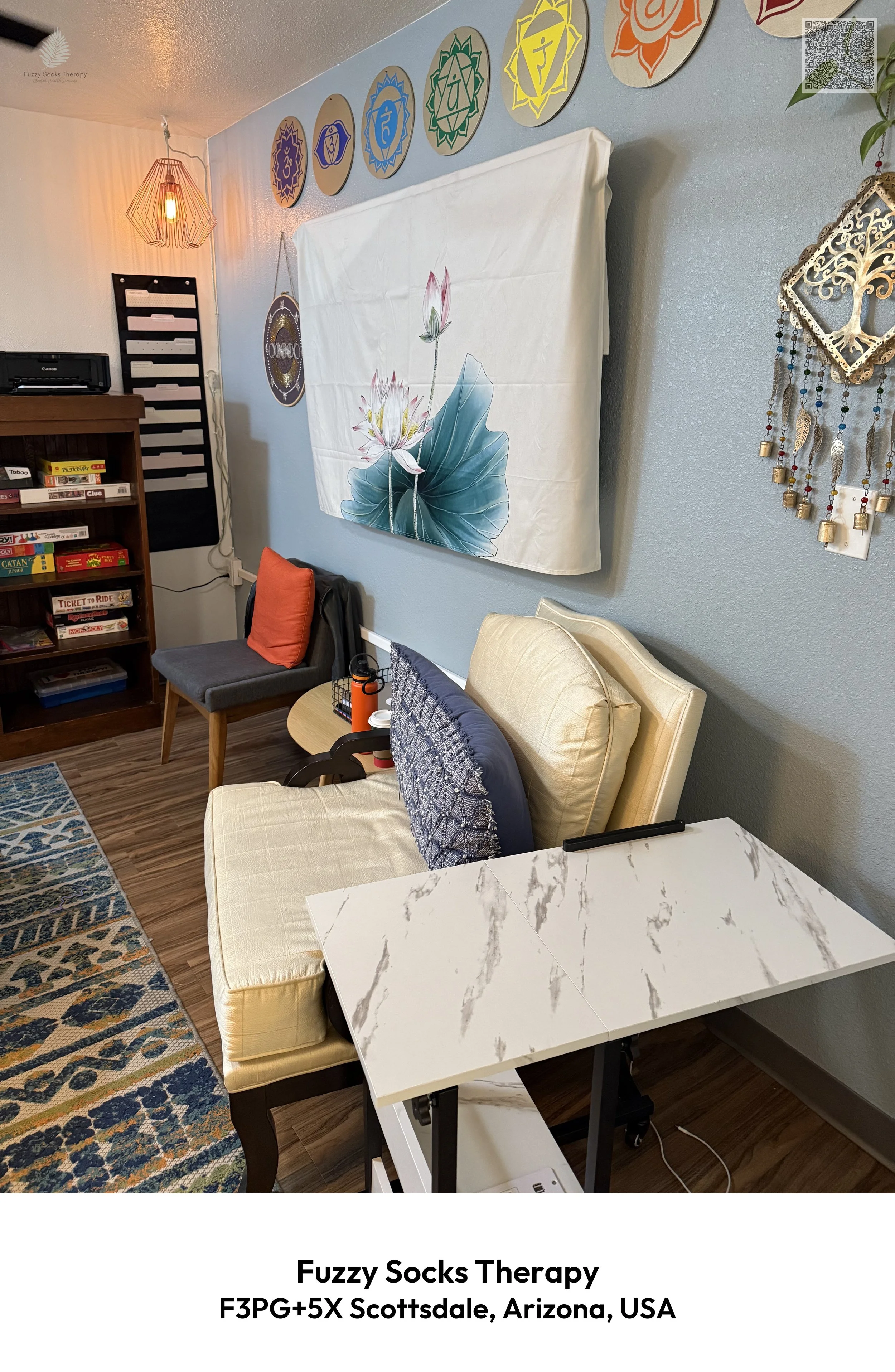
Open-location code (plus code): F3PG+5X Scottsdale, Arizona, USA
Map/listing URL: https://maps.app.goo.gl/cqhwvXU4UMg6QL1YA
Embed iframe:
The practice offers in-person therapy in Scottsdale along with online sessions for clients in Arizona, Colorado, and Florida.
Clients can explore services such as trauma therapy, EMDR therapy, Deep Brain Reorienting Therapy, neurodivergent therapy, child therapy, couples therapy, discernment counseling, and parenting intensives.
Fuzzy Socks Therapy is especially relevant for people navigating trauma, dysfunctional family dynamics, ADHD, autism, relationship conflict, and emotional overwhelm.
The website presents a direct, practical therapy style focused on real tools and meaningful change rather than vague advice.
Scottsdale clients looking for trauma-informed psychotherapy can find support that combines deeper healing work with concrete skill building.
The practice also offers help for adult children of dysfunctional families, couples on the brink, and neurodivergent kids, teens, and adults.
To get started, call (720) 378-8454 or visit https://www.fuzzysockstherapy.com/ to book a free consultation.
A public Google Maps listing is also available for Scottsdale location reference alongside the official website.
Popular Questions About Fuzzy Socks Therapy
What does Fuzzy Socks Therapy help with?
Fuzzy Socks Therapy helps with trauma, dysfunctional family patterns, neurodivergence, relationship conflict, emotional overwhelm, and related challenges for individuals, couples, and families.
Is Fuzzy Socks Therapy located in Scottsdale, AZ?
Yes. The official website lists the office at 3295 N. Drinkwater Blvd., Suite 10, Scottsdale, AZ 85251.
Does Fuzzy Socks Therapy offer in-person and online sessions?
Yes. The official site says the practice offers in-person therapy in Scottsdale and online therapy in Arizona, Colorado, and Florida.
What therapy approaches are listed on the website?
The website highlights EMDR therapy, Deep Brain Reorienting Therapy, discernment counseling, play therapy, Dialectical Behavior Therapy, Emotionally Focused Therapy, and practical trauma-informed skill building.
Who provides therapy at Fuzzy Socks Therapy?
The official website identifies the therapist as Lianna Purjes.
Does the practice offer couples counseling?
Yes. The website includes couples therapy, couples intensives, and discernment counseling for couples deciding whether to stay together or separate.
Does the practice work with children and adolescents?
Yes. The site says the practice offers child therapy and support for children, adolescents, and their families.
How can I contact Fuzzy Socks Therapy?
Phone: (720) 378-8454
Email: [email protected]
Website: https://www.fuzzysockstherapy.com/
Landmarks Near Scottsdale, AZ
Drinkwater Boulevard is the clearest local reference point for this office and helps nearby clients place the practice in Scottsdale. Visit https://www.fuzzysockstherapy.com/ for service details.
Old Town Scottsdale is a familiar city landmark and a practical reference for people searching for therapy near central Scottsdale. Call (720) 378-8454 to learn more.
Scottsdale Civic Center is another recognizable local landmark that helps define the surrounding area for nearby professional services. The official website has current contact details.
Scottsdale Stadium is a well-known destination in the city and a useful point of reference for local users. Fuzzy Socks Therapy offers both in-person and online sessions.
Indian School Road is a major corridor that helps many residents orient themselves in Scottsdale. More information is available at https://www.fuzzysockstherapy.com/.
Fashion Square and the surrounding central Scottsdale area are widely recognized by local residents and visitors alike. Reach out through the website to book a free consultation.
Downtown Scottsdale is a strong local search reference for people seeking counseling and psychotherapy services in the area. The practice serves Scottsdale in person and multiple states online.
Scottsdale Road is another major route that helps define the broader service area for clients traveling from nearby neighborhoods. The practice supports individuals, couples, and families.
The Scottsdale arts and civic district is a useful area reference for those familiar with the city center. Visit the site to review specialties and next steps.
Central Scottsdale commuter corridors make this practice relevant for nearby residents who want in-person therapy, while online sessions add flexibility for clients in Arizona, Colorado, and Florida.